San Diego tap water is hard: the City's water quality report lists average total hardness of about 13.8 to 14.2 grains per gallon for water from its three treatment plants. A softener pulls out the calcium and magnesium behind crusty aerators and sediment in water heaters, while a filter is the tool for taste and odor. Call the number on this page to be connected with a local plumber in San Diego who can install, repair or replace a water softener.
How hard the water is, and why
Most City of San Diego water is imported, a blend of Colorado River and State Water Project supplies bought through the San Diego County Water Authority, with some local reservoir runoff mixed in. It is treated at the Alvarado, Miramar and Otay plants. The City's report puts average total hardness from those plants at roughly 237 to 243 mg/L, or 13.8 to 14.2 grains per gallon. Purchased treated water averaged lower, about 8.5 grains per gallon, but either figure is well into hard-water territory.
That mineral load collects wherever water is heated or sits still. Tank heaters gather sediment, tankless heat exchangers scale up, shower cartridges get stiff and faucet screens clog.
Picking the right equipment
| Problem | What usually solves it |
|---|---|
| Spots, crust and scale throughout the house | Whole-house ion-exchange softener |
| Chemical taste or smell | Catalytic carbon filter rated for chloramine |
| Cleaner drinking water at the kitchen | Under-sink filter or reverse osmosis |
| Scale in a tankless unit | Softening upstream plus scheduled flushing |
One local detail matters here: the City uses chloramines, chlorine combined with ammonia, as the disinfectant in its pipes. Standard carbon is less effective on chloramine than on plain chlorine, so ask for media made for it if taste is the goal. A softener alone will not change taste.
Installing a softener
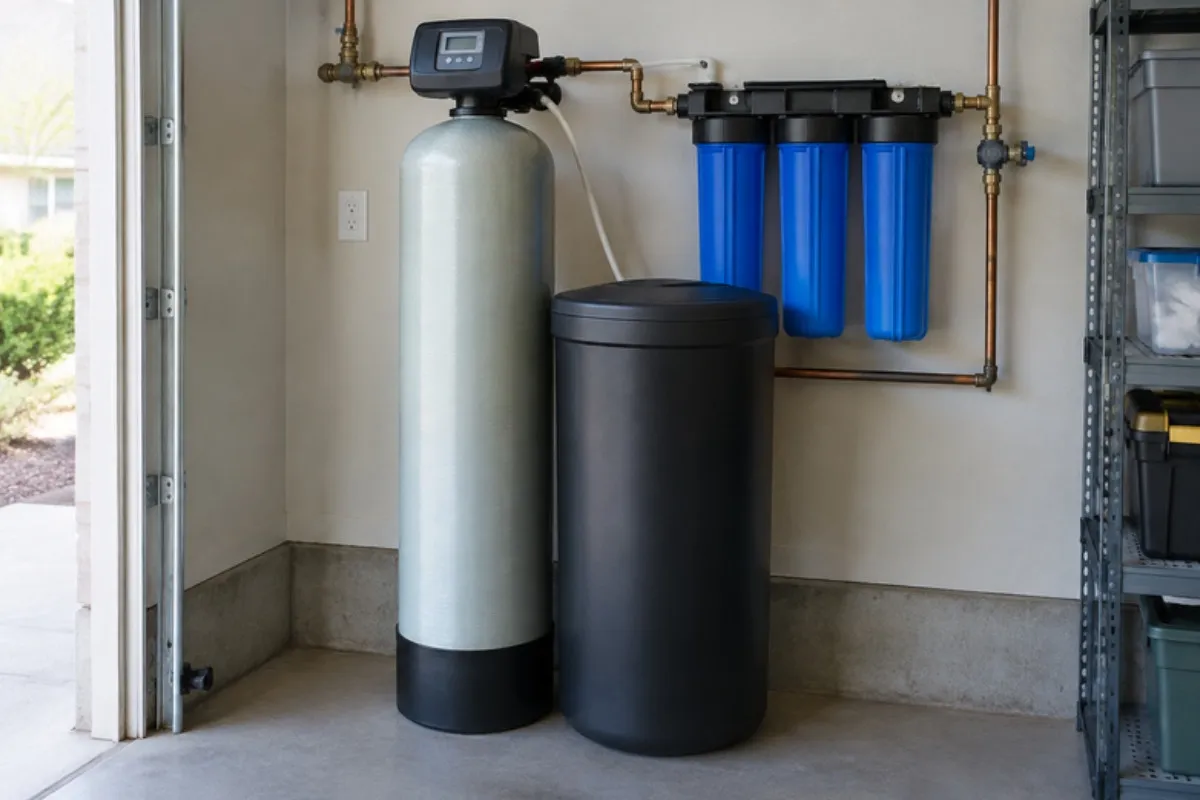
Many homes have no pre-plumbed loop, so the plumber cuts into the main line where it enters the house, adds a bypass valve, runs a drain for the brine cycle with a proper air gap, and finds an outlet for the control head. Garages are a common spot. Near the beach, an outdoor unit takes a beating from salt air, so a covered or indoor location lasts better. Many owners keep a cold line at the kitchen sink unsoftened for drinking and cooking.
Typical repair calls
- Hard water returns because salt has bridged in the brine tank.
- The timer or control valve regenerates at the wrong time or not at all.
- Drips from the bypass valve, head O-rings or resin tank fittings.
- A kinked or blocked drain line that floods the area during regeneration.
- An old, dead unit still plumbed in that restricts flow.
What drives the price
Cost comes down to the unit's size and type, how much piping is needed to reach the main, drain and power access, any added filtration, and the ongoing cost of salt and cartridges.
Water Softener questions from San Diego homeowners
How hard is City of San Diego water?
Will a softener remove the chlorine taste?
Where does a softener usually go in a San Diego house?
Does a tankless water heater need a softener?
Related plumbing services in San Diego
Water Softeners & Filtration in nearby cities and towns
San Diego County
Sources
Last updated: